
Some marriages end with a fight. Others end with a menu and two people who have forgotten how to order for each other.
Saturday night at a restaurant just nice enough for a reservation. A couple in their late fifties, maybe early sixties, seated by the window. They have been there for twelve minutes. I know because I was seated just after them, and in that time neither has said a word that wasn’t about the bread or the water or whether the parking meter needs more time. Their phones sit on the table like life rafts. The entrees are still twenty minutes away.
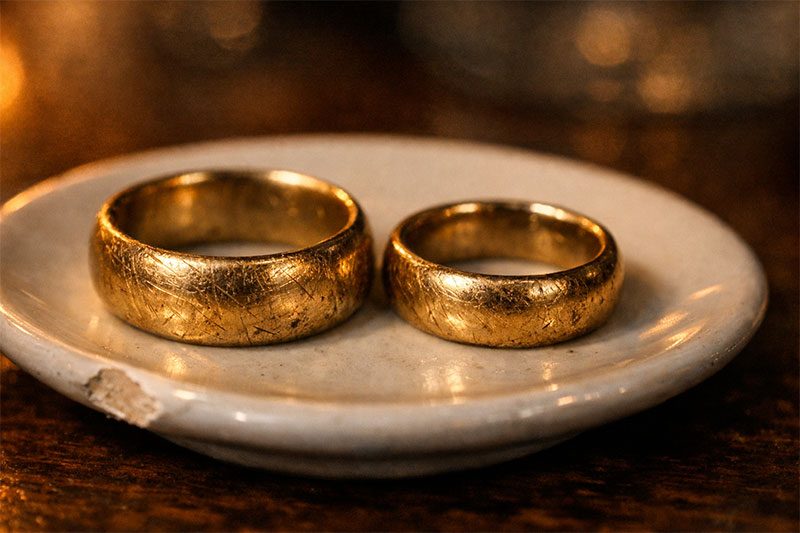
The Marriage That Worked
Isaac and Rebekah began with one of the most beautiful moments in all of Scripture. Genesis 24 tells the story of a servant sent across the desert to find a wife for Isaac, and Rebekah’s arrival is described with a kind of breathless precision: she came, she was brought to him, and he loved her, and she became his wife, and he was comforted after his mother’s death. Four things in one verse, like a life compressed into a single sentence.
Isaac brought her into the tent of his mother Sarah, and he married Rebekah. So she became his wife, and he loved her; and Isaac was comforted after his mother’s death.
Genesis 24:67 (NIV)
That verse sounds like an ending. It reads like the last page of a love story. And for a long time, in the silence of Genesis, it almost is. The next time we see Isaac and Rebekah with any real detail, decades have passed, the children are grown, and the household has split. The two of them are operating on opposite sides of the family, each backing a different son, each carrying a plan the other doesn’t fully know about.
Two Plans, One Table
By Genesis 27, the love story is nowhere in sight. Isaac, old and nearly blind, calls Esau to prepare a meal so he can give his blessing. Rebekah overhears. She doesn’t go to Isaac. She doesn’t sit with him and talk about what the blessing should look like or which son deserves what. She goes to Jacob and tells him to pretend to be his brother.
Now Rebekah was listening as Isaac spoke to his son Esau… Rebekah said to her son Jacob, “Look, I overheard your father say to your brother Esau… Now, my son, listen carefully and do what I tell you.”
Genesis 27:5-8 (NIV)
Read those verses carefully and what you find is a married couple who have stopped talking to each other. They still live in the same tent. They still share the same family. But somewhere between Genesis 24 and Genesis 27, the conversation ended. The partnership became two separate operations running under the same roof, each parent choosing a son the way you choose a side in a war you never declared.
Scripture doesn’t give us the middle. We get the love and the fracture, with nothing in between. Which is exactly what makes it so recognizable, because most couples who end up eating in silence can’t point to the middle either. There was no single moment. There was a slow drift measured in conversations that got shorter, plans that stopped being shared, evenings that filled with television instead of talk.
The Crisis Nobody Warns You About

Every marriage book, every sermon series, every couples retreat is built around surviving the hard season: the financial collapse, the affair, the diagnosis, the teenager who goes sideways. What nobody mentions is the morning after the storm passes. The kids are launched. The crisis is resolved or at least contained. And two people sit at a kitchen table with coffee and discover that for the last twenty years, the crisis was the conversation. The management was the intimacy. The shared project of raising children and surviving difficulty was the entire infrastructure of their connection, and without it, they are two competent strangers who know each other’s allergies but have lost the thread of each other’s inner life.
Isaac and Rebekah never had a recorded fight. They simply stopped turning toward each other somewhere in the ordinary middle, and by the time the blessing scene arrives, they are running parallel lives inside a shared tent.
Most people who find this page are not reading it together. One of them is reading it alone, in a room where the other person is close enough to hear if called but far enough away that calling feels like it would require an explanation. If that is your evening, someone else will sit in that same stillness and search for the same words, and keeping this page here when they do is one of the few things that can come from a hard night like yours.
The Second Choosing
Here is what I would say to the couple at the restaurant, if it were my place to say it, which it is not. The silence you are sitting in is real. It is the absence of a reason to speak that used to be provided for you by children and chaos and crisis, and now has to be built again from the ground up. That is a harder project than the first one, because the first time you fell in love without trying, and this time you will have to choose it with your eyes open, in a quiet room, with nothing forcing your hand.
The storm was only ever the clearing where the harder, quieter work of choosing each other again finally has room to begin.