
Same rabbi. Same road. Five completely different answers.
Four times in the Gospels, someone meets Jesus once and their life bends in a direction it was never going. One time, someone meets him and walks the other way. The ratio matters: four to one, yes to no, and the one who left carried more weight in the text than some of the ones who stayed. Here are the five, in the order they teach best.
1. The Woman at the Well
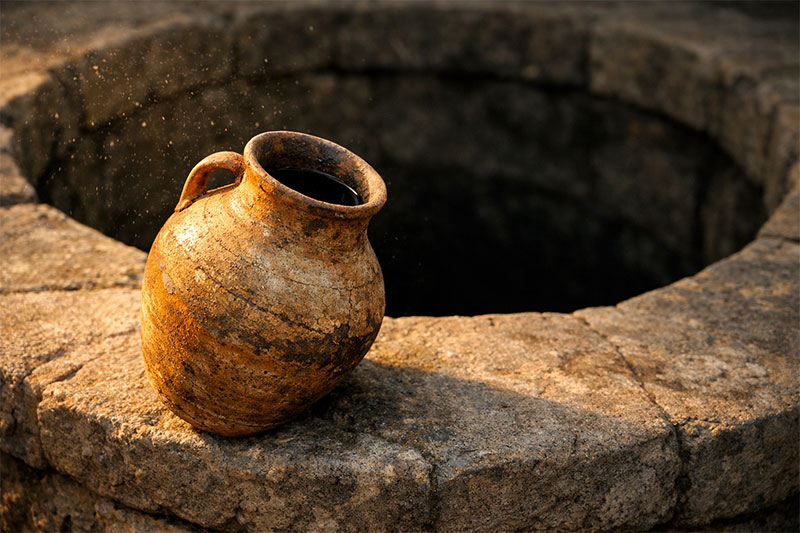
She came at noon because that was when nobody else came. Morning was for women who could stand next to each other without explanation, and she had run out of explanations several marriages ago. She brought a jar for water and a prepared silence for anyone who might be sitting nearby.
Jesus asked her for a drink. By the end of the conversation he had named everything she carried, and the text says she left her water jar at the well and ran into town. John includes that detail on purpose. You do not leave behind the thing you walked a mile in the sun to fill unless something inside you has already been filled instead. The woman who came to the well to avoid people went back to find them.
“Come, see a man who told me everything I ever did. Could this be the Messiah?”
John 4:29 (NIV)
2. Bartimaeus
He was a blind man sitting beside the road near Jericho, which means he had heard a thousand people pass and had learned to tell their footsteps apart. When the crowd moved differently that day, louder, closer together, with the particular energy of people following someone, he started shouting.
The crowd told him to stop. He shouted louder. Bartimaeus had been sitting in the dark long enough to know that this chance was not going to circle back. Jesus stopped and asked him a question that sounds almost strange: “What do you want me to do for you?” As if a blind man might want something other than sight. But Jesus asked anyway, because the asking mattered. Bartimaeus answered, received his sight, and followed Jesus down the road, which was the first road he had ever actually seen.
3. Zacchaeus

A chief tax collector in Jericho, which made him rich and completely alone. Tax collectors worked for Rome, and everyone knew it. Zacchaeus was short, and the crowd was thick, so he climbed a sycamore tree to see Jesus pass. A wealthy man in a tree is a man who has forgotten what he looks like to other people, which is usually the first sign that something honest is happening.
Jesus looked up, called him by name, and invited himself to lunch. By the end of the meal Zacchaeus stood and announced he would give half his possessions to the poor and repay four times what he had cheated from anyone. Nobody asked him to. One meal accomplished what years of guilt and isolation could not.
“Today salvation has come to this house.”
Luke 19:9 (NIV)
4. The Thief on the Cross

The shortest encounter on this list. Two criminals hung on either side of Jesus, and one of them mocked him while the other said something so simple it barely qualifies as theology: “Remember me when you come into your kingdom.” He had no time for a changed life, no opportunity to give anything back or follow anyone down any road. All he had was a sentence and whatever faith could be built in the time it takes to say it.
“Truly I tell you, today you will be with me in paradise.”
Luke 23:43 (NIV)
Jesus answered him immediately. The last person in the Gospels to say yes to Jesus did it with hours to live, and the yes was enough.
5. The Rich Young Ruler
He ran up to Jesus. Mark says that specifically: he ran. He knelt. He asked the right question: “What must I do to inherit eternal life?” He had kept all the commandments since he was a boy. Mark adds one more detail that is easy to miss: “Jesus looked at him and loved him.”
Then Jesus told him to sell everything and follow. And the young man’s face fell. He went away sad, because he had great wealth.
“He went away sad, because he had great wealth.”
Mark 10:22 (NIV)
He is the only person on this list who walked away. The text does not say Jesus called after him. It does not say the man looked back.
Five encounters, and the one that stays longest is the unfinished one. I have noticed something similar with these pages. The readers who write back are almost never the ones who read straight through. They are the ones who closed the tab somewhere around the third or fourth section, carried a sentence with them for a few days, and came back to finish. Something in the article had named them, and they were not ready for it yet. That is what these pages are for: to still be here when someone returns. If you have come back to something here that waited for you, you already know what it means to keep a page standing for whoever needs it next.
What Stays
Four people said yes in completely different circumstances: a woman hiding from her past, a blind man shouting over a crowd, a tax collector in a tree, a dying criminal with nothing left to offer. The fifth had everything, asked the right question, received a direct answer from Jesus who loved him while giving it, and still walked away. The Gospels never tell us whether he came back, and that silence has outlasted every sermon ever preached about him.